Antimicrobial Resistance Surveillance in BeninTABLE OF CONTENTS
Happy New Year 2026! 🎄✨May this new year be guided by health, commitment, and shared success. 1. Message from the Network Coordinator
The second half of 2025 was marked by sustained momentum toward the consolidation of the Benin Bacteriology Laboratory Network. The activities implemented strengthened human capacities, improved the quality of diagnostics, introduced innovative tools, and enhanced the network's national and international visibility. This issue of the newsletter highlights the main activities carried out, the main achievements, and the perspectives ahead, in a context defined by the urgent need to effectively combat antimicrobial resistance. As the new year approaches, the coordination team of the Benin Bacteriology Laboratory Network extends its sincere thanks to all teams, partners, and collaborators for their commitment, professionalism, and collaborative spirit throughout 2025. We wish you happy end-of-year celebrations and a successful year 2026, marked by health, innovation, capacity strengthening, and collective achievement. May the coming year consolidate our gains, address new challenges, and allow us to continue working together to combat antimicrobial resistance in service of the population.
Prof. Dissou AFFOLABI, 2. Network Strengthening and GovernanceFollowing the supervision of the network laboratories in June 2025, a two-week internship was organized at the bacteriology laboratory of the National University Hospital Center Hubert Koutoukou Maga (CNHU-HKM) in Cotonou, the central level of the network, for the heads of bacteriology sections from newly affiliated hospitals, namely La Croix Hospital of Zinvié, the Mono Departmental Hospital Center (CHD Mono), and the Borgou Departmental University Hospital Center (CHUD Borgou). This initiative enabled participants to become familiar with the organization of a bacteriology laboratory and to strengthen their skills at both technical and managerial levels. Furthermore, the VLIR-UOS training on antimicrobial resistance management continued successfully. Two consecutive sessions brought together forty health professionals from twenty hospitals in Benin, as well as from other countries such as Guinea and the Democratic Republic of Congo. Despite the diversity of epidemiological contexts, all participants shared a common ambition: to reduce antimicrobial resistance in resource-limited settings.
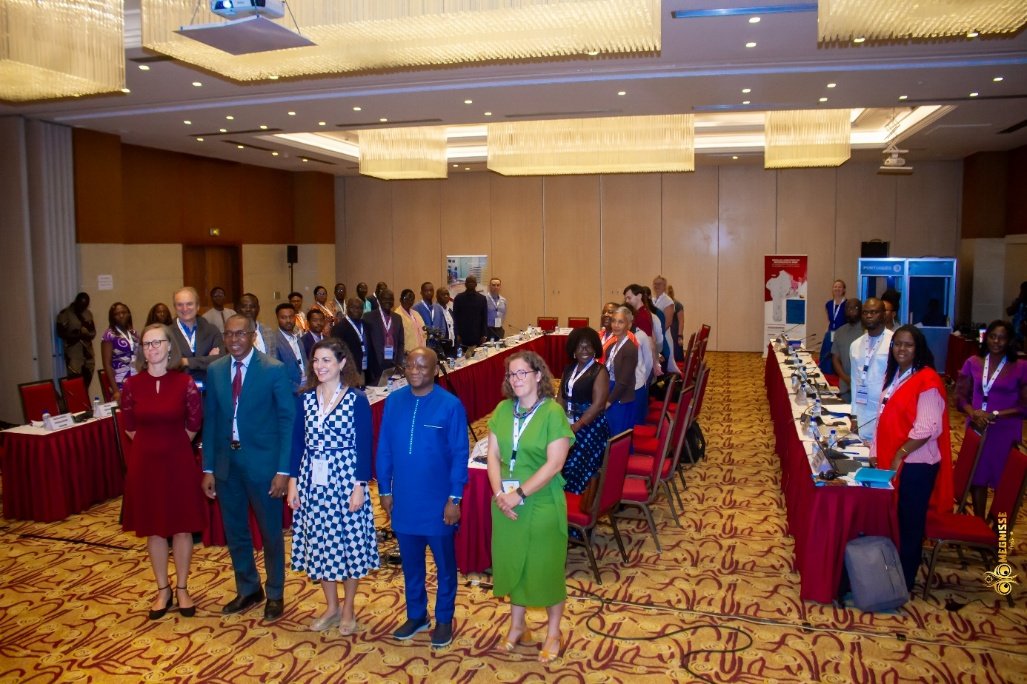
This momentum concluded with the network's annual review meeting, held on December 29, 2025, in Cotonou. The meeting reviewed the network's expansion from 10 laboratories in 2024 to 15 in 2025, analyzed technical performance, identified strengths and challenges, and formulated recommendations to consolidate achievements. The meeting was also marked by the participation of key Ministry of Health stakeholders, including Dr. Tokpanou Koudjo, Director of Hospital Facilities, and Dr. Alban Zohoun, Director of Diagnostic Investigations. They shared with network members the main antimicrobial resistance (AMR) control initiatives currently underway at the central level of the Ministry of Health and emphasized the importance of establishing a coordination framework among the various AMR stakeholders to promote synergistic action.
4. Projects, Research, and PartnershipsThese technical advances are part of a broader framework of structured projects and strategic partnerships. 4.1. SIMBLE ProjectThe SIMBLE project, launched in 2021, was officially completed in September 2025. This study developed and evaluated a simplified blood culture system (BactInsight), including local production of blood culture bottles, implementation of innovative tools, and field evaluations conducted in Benin and Burkina Faso. The project significantly contributed to strengthening local capacities and promoting diagnostic innovation adapted to resource-limited settings. 
4.2. Culture Media ProductionIn parallel, the bacteriology culture media production unit of SRL-Cotonou continued its upward trajectory, with increased production capacity and the successful completion of a first phase of the ISO 9001 certification audit.
4.3. Partnership with LADISEROIn response to challenges related to the supply of sheep bloodfor the preparation of culture media, the network also established a strategic partnership with the Parakou Veterinary Diagnostic and Serosurveillance Laboratory (LADISERO). This collaboration, formalized through the signing of a contract, enabled the construction of a dedicated facility for the aseptic collection of sheep blood, ensuring a secure and sustainable supply for the laboratories within the network. 5. Special Highlight – Visit of the Director of the Institute of Tropical MedicineIn September 2025, SRL-Cotonou had the honor of welcoming Professor Özge Tunçalp, Director of the Institute of Tropical Medicine (ITM) in Antwerp, as part of the long-standing collaboration between the two institutions. This visit provided an opportunity to showcase the activities carried out in support of the development of the bacteriology laboratory network and the local production of culture media. SRL-Cotonou was recognized as a reference model for the region, with strong prospects for further strengthening this cooperation and sharing this experience beyond Benin. 

6. Data, Surveillance, and VisibilityThe activities implemented also contributed to strengthening the production, management, and use of antimicrobial resistance surveillance data. Ongoing reflections aim to optimize the use of existing data management tools (WHONET, LABBOOK, GESTLAB, etc.) to ensure reliable, harmonized, and actionable data. In terms of visibility, the network strengthened its presence on the international stage through its participation in the colloquium of the Institute of Tropical Medicine in Antwerp . On this occasion, Prof. Liselotte Hardy and Dr. Faridath Massou co-chaired a session entitled “Accessible Diagnostics and Health Technologies” , which showcased technological innovations developed across the world. The session also provided an opportunity to present the results of the Tropicare, study, conducted at the Departmental Hospital Centre (CHD) of Zou. This study demonstrated the feasibility of implementing tropicalized automated diagnostic platforms under real-world conditions, with the support of FIND. 
The colloquium also provided a valuable platform for exchanges with partners involved under the FA5 Framework Agreement, at both international and national levels. On this occasion, the team discussed key issues related to the management of neonatal sepsis with partners from the Centre de Recherche en Reproduction Humaine et en Démographie (CERRHUD) Want to read more?
You may also like
| |||||||||||||||||||||||||||||||||||||||